UNIST site map
- Admissions
-
Academics
- Colleges and Schools
-
Academic Affairs
- Academic Calendar
- Academic Curriculum
- Requirements for Graduation
- Browse Open Courses
- Undergraduate Administration
-
Graduate Academic Affairs
- Tuition Fee Payment
- Academic Leave of Absence/ Academic Return
- Voluntary Withdrawal/ Expulsion
- Change of Major
- Change of Degree Program/ Dropping of Degree Program
- Class Period/ Attendance Period/ Academic Year・Semester
- Course Registration
- Course Drop
- Attendance/ Grade/ Exam
- Credit Transfer/ Credit Carryover
- Academic Forms
- Education Support
-
Research/Industry
- Research Aims
- Research Findings
- Researcher Search
-
Research Organizations
- UNIST Multi-Interdisciplinary Institute
- IBS Research Groups
-
UNIST Labs
- Department of Mechanical Engineering
- School of Energy and Chemical Engineering
- Department of Civil
- Department of Materials Science and Engineering
- Department of Nuclear Engineering
- Department of Industrial Engineering
- Department of Design
- Department of Biomedical Engineering
- Department of Biological Sciences
- Department of Electrical Engineering
- Department of Computer Science and Engineering
- Department of Mathematical Sciences
- Department of Chemistry
- Department of Physics
- School of Business Administration
- Graduate School of Carbon Neutrality
- Graduate School of Artificial Intelligence
- Research Support
- University-Industry Relations
- Campus Life
- News Center
- About UNIST
-
etc
- UNIST Bulletin
- Work-Life Balance Support System
- UNIST Gender Equality Plan
- Faculty Invitation for Tenure Track
- Faculty Invitation for Non-Tenure Track
- Board Meeting Minutes
- University Council Meeting Minutes
- Administrative Service Charter
- Privacy Policy
- Copyright Policy
- Rejection of Unauthorized Email Collection
- Operation and Management Policy for Video Information Processing Devices
- Information Disclosure


Connection Points of Knowledge, Everything About UNIST
Try searching.
Recommended search terms


- portal
- U Academics Innovation Center
- Leadership Center
- Dormitory
- Academic Information Center
- International Students Support
- Browse Open Courses
- Course Registration
- Graduation Requirements for Graduation
- Academic Leave of Absence/ Academic Return
- Military Service
- Certificate Issuance
- Academic Calendar
- Scholarships
- Campus Map
- Campus Life Guidebook
- Health Care Center
- Human Rights Center
- portal
- Job Opening
- Announcement for Bid
- UNIST AI Services
- UNIST Daycare Center
- Sports Center
- UI Downloads
- Announcement
- Recruitment of Professors (Non-tenure)
- Faculty Invitation for Tenure Track
- UNIST Academic Information Center
- Office of Research Facilities and Training
- Office of Research Affairs
- Rule Management System
- Academic Calendar


This is a collection of menus necessary for UNIST students .
students
- portal
- U Academics Innovation Center
- Leadership Center
- Dormitory
- Academic Information Center
- International Students Support
- Browse Open Courses
- Course Registration
- Graduation Requirements for Graduation
- Academic Leave of Absence/ Academic Return
- Military Service
- Certificate Issuance
- Academic Calendar
- Scholarships
- Campus Map
- Campus Life Guidebook
- Health Care Center
- Human Rights Center


This is a collection of menus necessary for prospective UNIST Students .
prospective Students


This is a collection of menus necessary for UNIST Faculty & Staff .
Faculty & Staff
- portal
- Job Opening
- Announcement for Bid
- UNIST AI Services
- UNIST Daycare Center
- Sports Center
- UI Downloads
- Announcement
- Recruitment of Professors (Non-tenure)
- Faculty Invitation for Tenure Track
- UNIST Academic Information Center
- Office of Research Facilities and Training
- Office of Research Affairs
- Rule Management System
- Academic Calendar

NEWS CENTER
Discover not only Research Findings and event news, but also the diverse facets of UNIST presented by reporters and writers.
News Center

UNIST News
Innovative Nanoscale Design Produces Stronger Signals When Bent
Published in Science Advances, innovative nanoscale design produces stronger signals when bent, challenging conventional assumptions.
- Research
- JooHyeon Heo
- 2026.05.22
- 285

Abstract
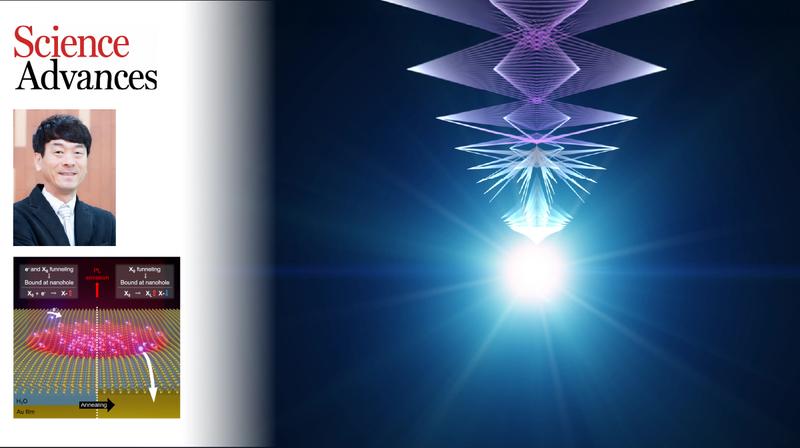
A collaborative team from UNIST and Ajou University has unveiled a flexible optical device that generates a stronger light signal when bent. This achievement defies the traditional understanding that mechanical deformation diminishes optical performance, paving the way for advanced wearable sensors and flexible photonic systems.
Led by Professors Hyeong-Ryeol Park and Seon Namgung of UNIST Department of Physics, alongside Professor Young-Hwan Ahn at Ajou University, the team engineered a device capable of converting incident light into a shorter wavelength. Unlike conventional devices that depend on bulky, thick materials, this ultra-thin structure employs molybdenum disulfide (MoS2), a two-dimensional semiconductor only a few atoms thick.
While bending MoS2 typically weakens its optical signals, the researchers redesigned the architecture to focus electromagnetic energy within nanoscale gaps—merely 20 nanometers wide—that concentrate fields during compression. When bent inward, these gaps are narrow, amplifying the emitted light. On the other hand, when relaxed, they widen, diminishing the signal. This dynamic modulation renders the device both strain-sensitive and capable of real-time optical control.

Experimental results demonstrated that compressing the device by approximately 1.2% increased its second-harmonic output—converting 800 nm light to 400 nm—by nearly threefold. Within these nanoscale gaps, the local electromagnetic field exceeds 8,000 times that of a flat MoS₂ film on gold. Notably, the device maintained over 95% of its initial performance even after 190 bending cycles, with minimal material degradation.
“This nanoscale design not only enhances the optical signal but also provides inherent protection for the material,” said lead researcher Sobhagyam Sharma from UNIST. “It offers a straightforward approach to developing flexible sensors that respond to mechanical stress through changes in light emission.”
Professor Park added, “This innovation lays the groundwork for deformation sensors that operate via optical signals and offers new insights into strain effects on two-dimensional materials.”
The findings were published in Science Advances on May 8, supported by the National Research Foundation of Korea (NRF), the Institute for Information & Communications Technology Planning & Evaluation (IITP), and UNIST.
Journal Reference
Sobhagyam Sharma, Satyabrat Behera, Byung Hee Son, et al ., “Reconfigurable second-harmonic generation via plasmonic nanoslits counteracting strain-induced suppression in monolayer MoS2,” Sci. Adv., (2026).
Related Links