UNIST site map
- Admissions
-
Academics
- Colleges and Schools
-
Academic Affairs
- Academic Calendar
- Academic Curriculum
- Requirements for Graduation
- Browse Open Courses
- Undergraduate Administration
-
Graduate Academic Affairs
- Tuition Fee Payment
- Academic Leave of Absence/ Academic Return
- Voluntary Withdrawal/ Expulsion
- Change of Major
- Change of Degree Program/ Dropping of Degree Program
- Class Period/ Attendance Period/ Academic Year・Semester
- Course Registration
- Course Drop
- Attendance/ Grade/ Exam
- Credit Transfer/ Credit Carryover
- Academic Forms
- Education Support
-
Research/Industry
- Research Aims
- Research Findings
- Researcher Search
-
Research Organizations
- UNIST Multi-Interdisciplinary Institute
- IBS Research Groups
-
UNIST Labs
- Department of Mechanical Engineering
- School of Energy and Chemical Engineering
- Department of Civil
- Department of Materials Science and Engineering
- Department of Nuclear Engineering
- Department of Industrial Engineering
- Department of Design
- Department of Biomedical Engineering
- Department of Biological Sciences
- Department of Electrical Engineering
- Department of Computer Science and Engineering
- Department of Mathematical Sciences
- Department of Chemistry
- Department of Physics
- School of Business Administration
- Graduate School of Carbon Neutrality
- Graduate School of Artificial Intelligence
- Research Support
- University-Industry Relations
- Campus Life
- News Center
- About UNIST
-
etc
- UNIST Bulletin
- Work-Life Balance Support System
- UNIST Gender Equality Plan
- Faculty Invitation for Tenure Track
- Faculty Invitation for Non-Tenure Track
- Board Meeting Minutes
- University Council Meeting Minutes
- Administrative Service Charter
- Privacy Policy
- Copyright Policy
- Rejection of Unauthorized Email Collection
- Operation and Management Policy for Video Information Processing Devices
- Information Disclosure


Connection Points of Knowledge, Everything About UNIST
Try searching.
Recommended search terms


- portal
- U Academics Innovation Center
- Leadership Center
- Dormitory
- Academic Information Center
- International Students Support
- Browse Open Courses
- Course Registration
- Graduation Requirements for Graduation
- Academic Leave of Absence/ Academic Return
- Military Service
- Certificate Issuance
- Academic Calendar
- Scholarships
- Campus Map
- Campus Life Guidebook
- Health Care Center
- Human Rights Center
- portal
- Job Opening
- Announcement for Bid
- UNIST AI Services
- UNIST Daycare Center
- Sports Center
- UI Downloads
- Announcement
- Recruitment of Professors (Non-tenure)
- Faculty Invitation for Tenure Track
- UNIST Academic Information Center
- Office of Research Facilities and Training
- Office of Research Affairs
- Rule Management System
- Academic Calendar


This is a collection of menus necessary for UNIST students .
students
- portal
- U Academics Innovation Center
- Leadership Center
- Dormitory
- Academic Information Center
- International Students Support
- Browse Open Courses
- Course Registration
- Graduation Requirements for Graduation
- Academic Leave of Absence/ Academic Return
- Military Service
- Certificate Issuance
- Academic Calendar
- Scholarships
- Campus Map
- Campus Life Guidebook
- Health Care Center
- Human Rights Center


This is a collection of menus necessary for prospective UNIST Students .
prospective Students


This is a collection of menus necessary for UNIST Faculty & Staff .
Faculty & Staff
- portal
- Job Opening
- Announcement for Bid
- UNIST AI Services
- UNIST Daycare Center
- Sports Center
- UI Downloads
- Announcement
- Recruitment of Professors (Non-tenure)
- Faculty Invitation for Tenure Track
- UNIST Academic Information Center
- Office of Research Facilities and Training
- Office of Research Affairs
- Rule Management System
- Academic Calendar

NEWS CENTER
Discover not only Research Findings and event news, but also the diverse facets of UNIST presented by reporters and writers.
News Center

UNIST News
New Study Uncovers Current-Driven Spin Polarization in Chiral Nanowires
The findings of this research were published in ACS Nano on April 23, 2026.
- Research
- JooHyeon Heo
- 2026.05.21
- 267
Abstract
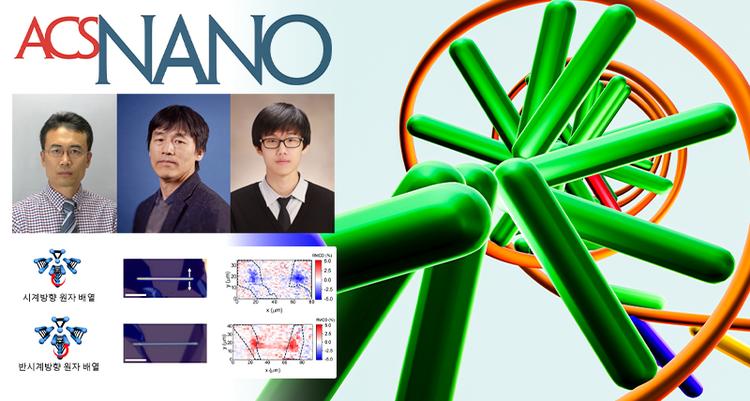
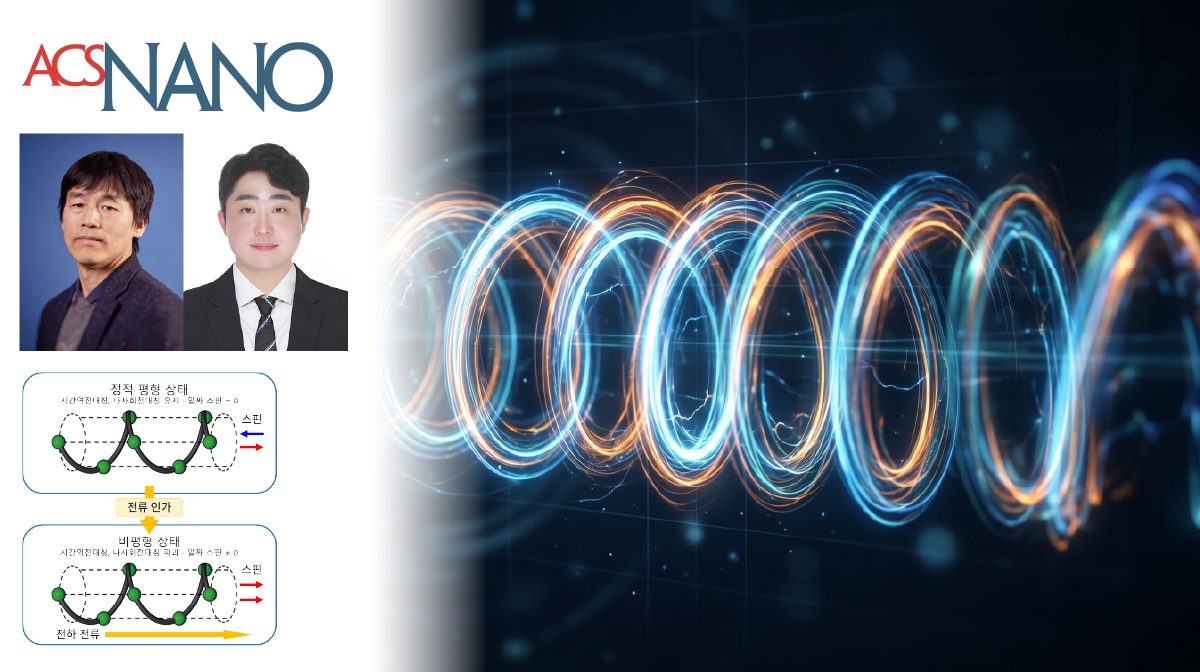
A new theoretical study shows that simply passing an electric current through chiral, helical materials can generate the intrinsic spin of electrons. Using real-time quantum calculations, researchers tracked how electron motion transforms into spin and orbital angular momentum.
Led by Professor Noejung Park from the Department of Physics at UNIST, the team partnered with scientists from the University of Missouri, Pennsylvania State University, and the Max Planck Institute. They simulated electrons flowing through a one-dimensional helical conductor—specifically selenium nanowires—and uncovered the microscopic process behind spin polarization.
Electrons carry two types of angular momentum: spin and orbital. Under normal conditions, these cancel out. But in chiral structures, an electric current favors electrons with a specific spin, creating a phenomenon known as chirality-induced spin selectivity (CISS). This effect enables spin control without magnetic fields, promising for spintronic devices. Yet, how current drives this spin polarization remained unclear.
The simulations revealed that as electrons move along the helix, their linear momentum converts into orbital angular momentum. This transfer, driven by the current, couples with the electron’s spin via quantum spin-orbit interaction, leading to a net spin polarization. Notably, this process activates only above a certain current threshold and persists even after the electric field is turned off.
Professor Park explains, “Our work shows that the flow of current itself creates and sustains spin polarization in chiral conductors. It highlights a fundamental mechanism—orbital angular momentum transfer—that can be harnessed for next-generation spintronic devices operating purely on electrical signals.”
The findings were published in ACS Nano on April 23, 2026. The study has been supported by the National Research Foundation of Korea (NRF) grants funded by the Ministry of Science and ICT (MSIT), and by a KIAT grant funded by the Ministry of Trade, Industry, and Energy (MOTIE).
Journal Reference
Uiseok Jeong, Daniel Hill, Esmaeil Taghizadeh Sisakht, et al., "Current-Driven Symmetry Breaking and Spin–Orbit Polarization in Chiral Wires," ACS Nano, (2026).
Related Links

-
Innovative Nanoscale Design Produces Stronger Signals When Bent
-
Mathematical Foundations for Noise-Tolerant Quantum Catalysts in Real-World Environments
-
AI-Optimized Vanadium Oxide Multilayers for More Than 20-fold Enhancement in Bolometric Performance
-
New Study Reveals How Chirality Controls Electron Spin Direction